
corpus n., pl. corpora — a platform for running a sociological study

/ˈkɔːpəs/ · Lat. body

1.A word processor, spreadsheets, coding software, an online survey tool and a shared folder.

one platform
for the whole study

corpus is a web platform for sociologists. It lets you run an entire empirical study in one place: participants and consent, interviews and transcripts, field notes, surveys, networks, coding, quotes and data export to R. Every change is logged, raw data is never overwritten, and every figure and quote keeps its provenance. Data is hosted in France.

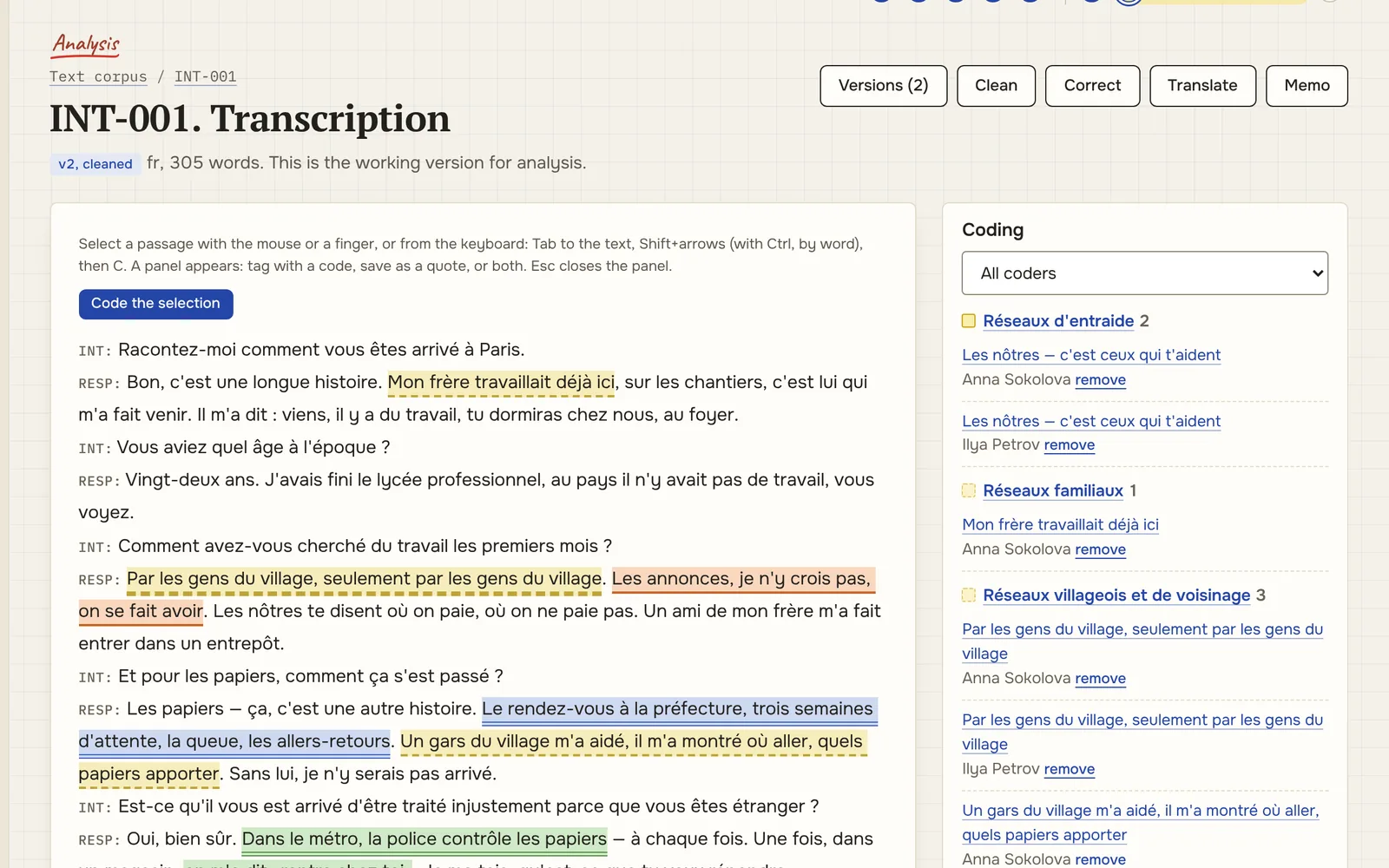
An interview in corpus: the transcript on the left, passages highlighted by code, the list of codes on the right.
an interview, coded
§ 01 — the problem

too many programs for one study

An empirical study is usually run across several programs that do not talk to each other: transcripts in a word processor, coding in qualitative analysis software, the survey in an online survey tool, response cleaning in spreadsheets, networks in separate graph software, literature in a reference manager, consent forms in a paper binder. What links them together is file names and the researcher’s memory. This leads to four recurring problems.

  1. Scattered data

    The interview recording on a voice recorder, the transcript in an email, the consent form on paper, the survey answers in a separate spreadsheet.

    In corpus, the interview, its transcript, the survey answers and the consent form are linked to one participant under a code (for example P-014) and open from a single page.

  2. Untraceable versions

    Files called “final”, “final_2”, “edits”. What changed, who changed it and when can no longer be established.

    Every processing step on a transcript — cleaning, anonymisation, translation — creates a new version. The original text is kept, and any two versions can be compared word by word.

  3. Provenance that cannot be recovered

    A supervisor or reviewer asks where the 38% comes from and which questionnaires it was computed on. The answer has to be reconstructed from memory.

    Every exported figure links back to the raw answers and cleaning rules, every quote to the transcript version and line.

  4. Poorly protected personal data

    Participant names in file names, transcripts on a personal laptop or in cloud services hosted outside the EU.

    Participant names and contact details are encrypted and never appear in exports. The server is in France.

§ 02 — what’s inside

modules n. pl.

Screenshots of the platform, version 0.6, on a demo study with fictional data. The qualitative and quantitative data of one study are handled in a single environment. Everything exports to open formats — CSV, JSON, DOCX, R, GraphML — readable without corpus.

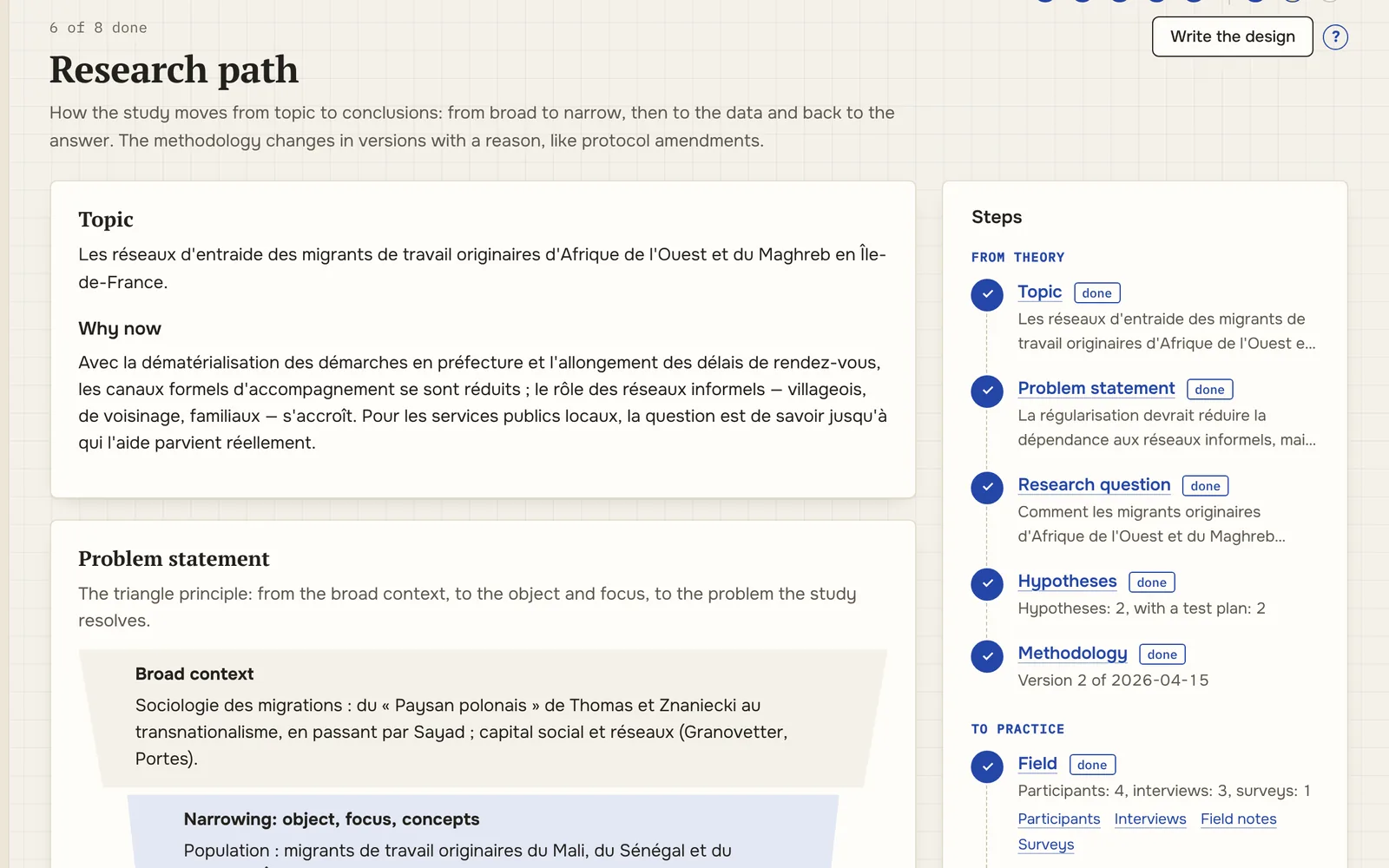
  • The research path: topic, research problem, hypotheses, fieldwork and analysis, with the state of each step.
    the research path

    Topic, problem, question, hypotheses, methodology, fieldwork, analysis, conclusions. Changes to the methodology are saved as versions with a reason.

  • An interview being coded: highlighted passages, codes and coders.
    coding an interview

    A transcript passage gets a code or becomes a quote, with the participant, text version and line.

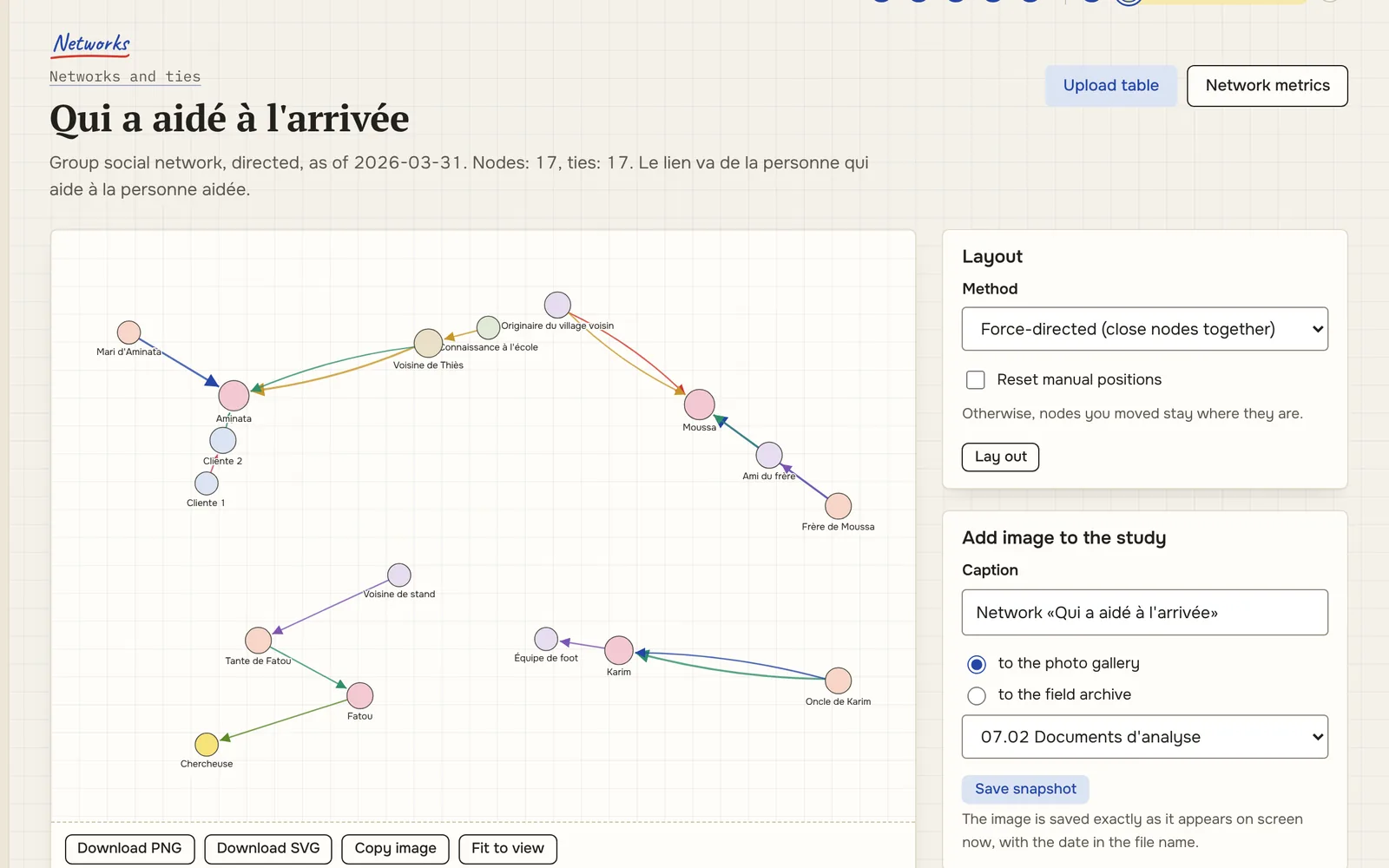
  • A network of relations drawn from an “individual — tie type — individual 2” table.
    network of ties

    The “individual — tie type — individual 2” table becomes a graph; density, degree, betweenness and communities are computed.

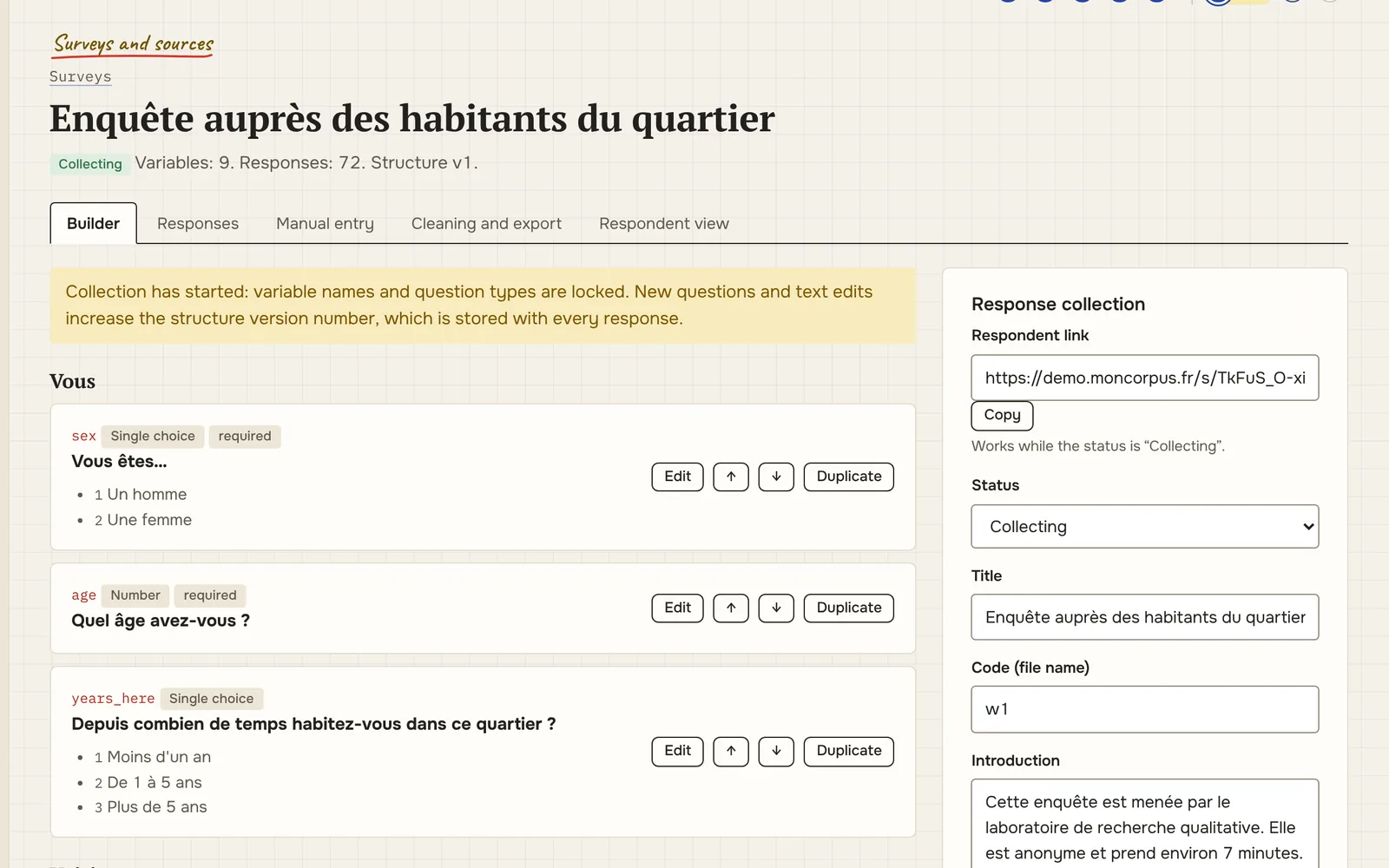
  • The survey editor with its questions and response collection.
    survey

    Survey builder, collection by link, cleaning rules with reasons, export to R with a variable dictionary.

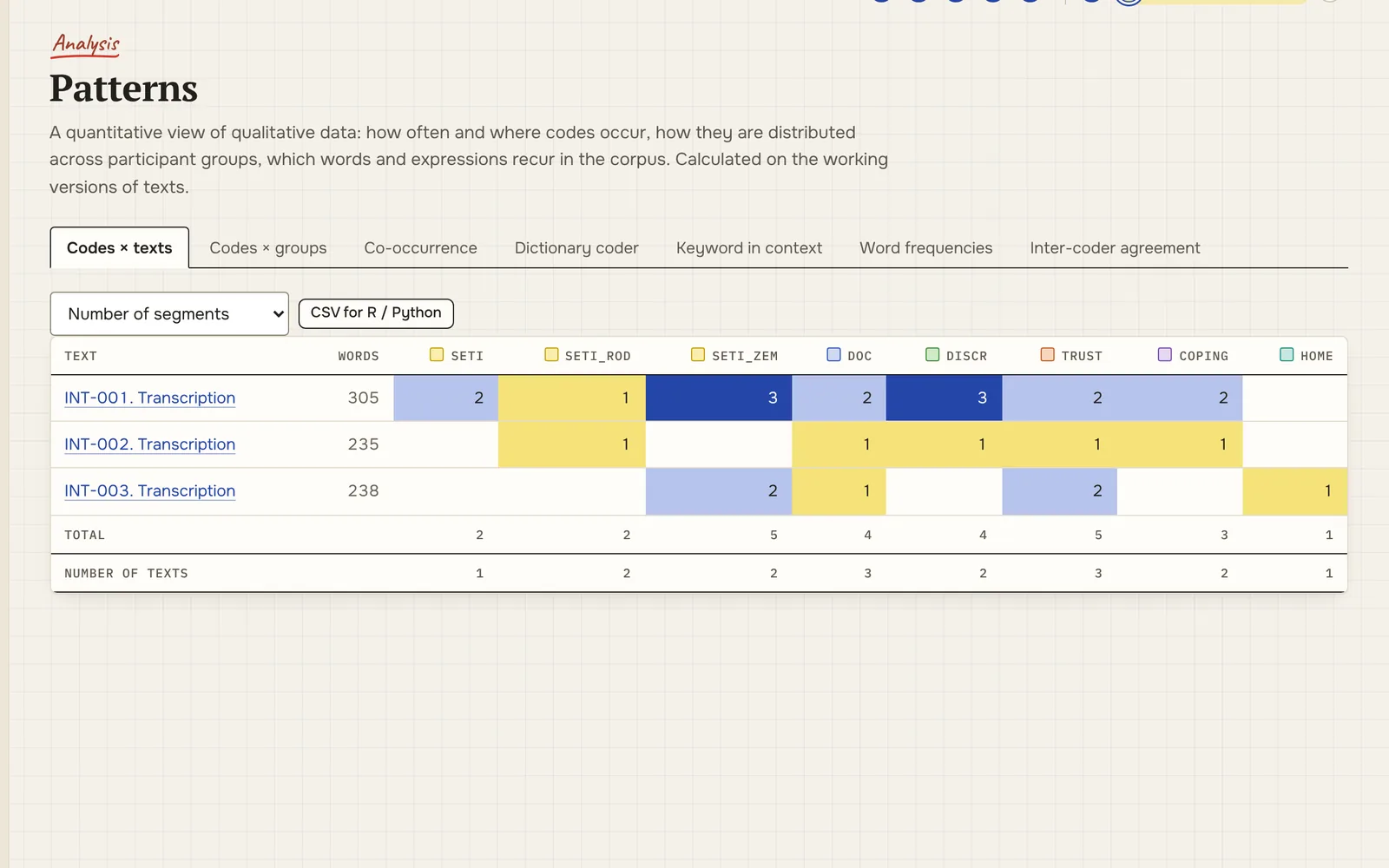
  • A codes × texts matrix showing where each code appears.
    codes × texts

    Which interviews and which participant groups each code appears in.

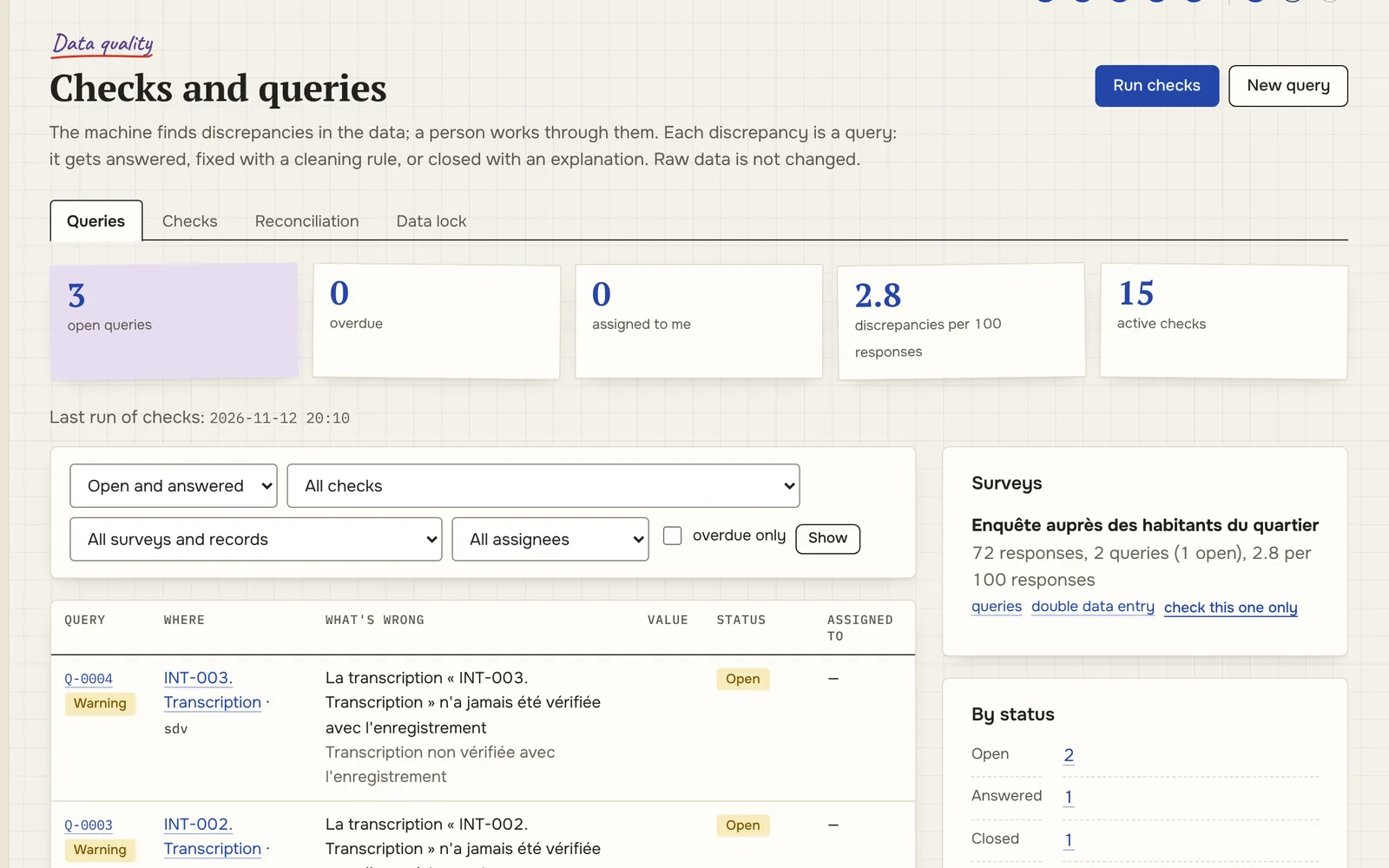
  • Data quality checks and open queries.
    checks and queries

    Entry checks catch inconsistencies; a doubtful value becomes a query to whoever entered it.

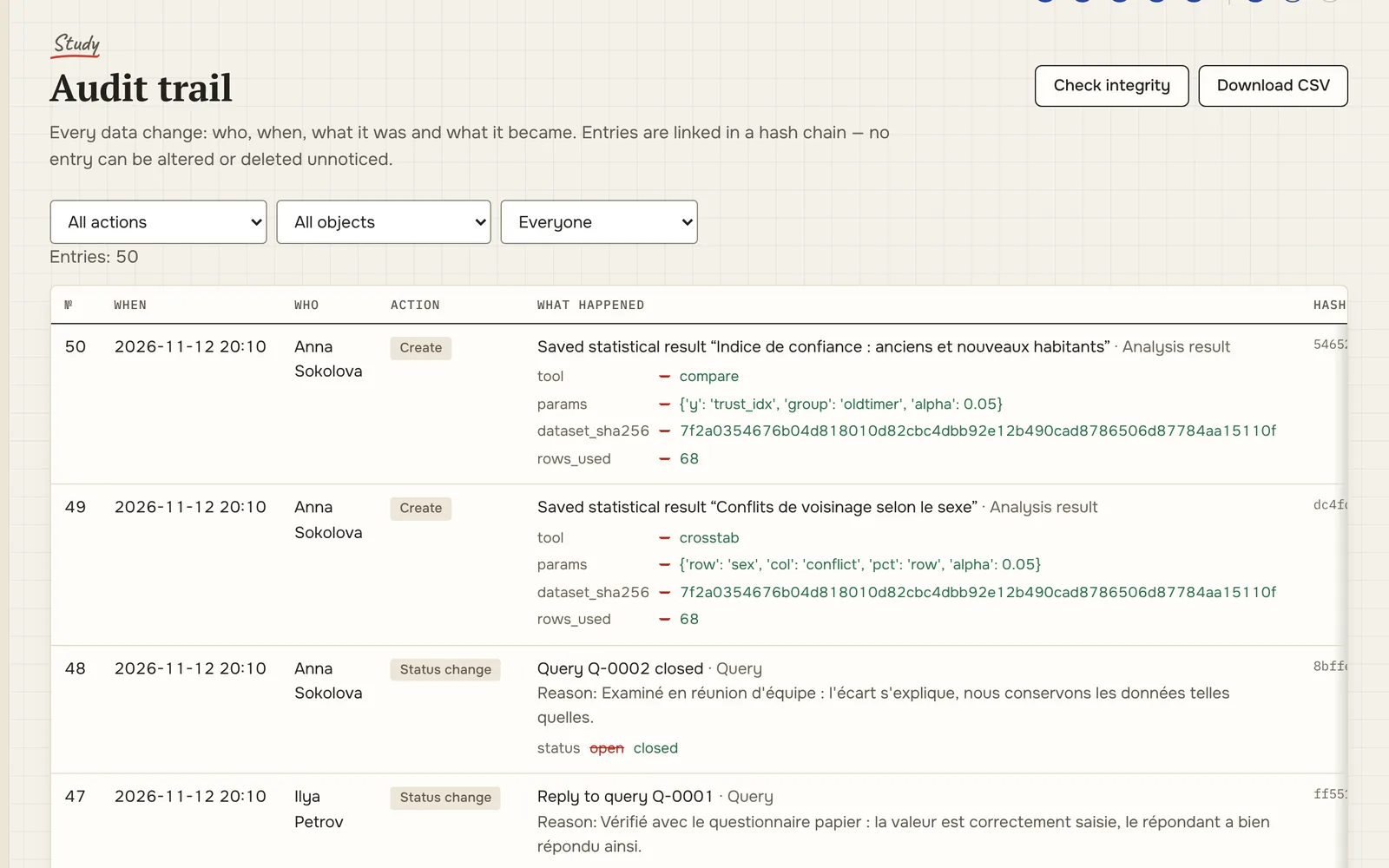
  • The audit trail: who, what, when, before and after.
    audit trail

    Who changed what and when, the value before and after. Entries are linked in a hash chain.

← scroll →

all features

§ 03 — principles

ALCOA+ abbr.

ALCOA+ is the data quality standard used in clinical trials. It requires every record to be attributable, legible, contemporaneous, original and accurate, as well as complete, consistent, enduring and available. corpus applies these requirements to sociological data: for every record you can see who entered or changed it, when and why.

ALCOA+ research receipt

A attributable
author of each record
L legible
open formats
C contemporaneous
server time
O original
source intact
A accurate
corrections with reasons
+C complete
deletion with reasons
+C consistent
shared codes
+E enduring
archive package
+A available
export and API

sha256 3f9a 07c2 … b81e c21e

intact ✓
§ 04 — data and security

hosting n.

The data of a sociological study almost always includes personal data. Storage and protection requirements are therefore built into the design of the platform.

  • § 01COR-FR

    Servers in France

    The platform and study data are hosted by a French provider on servers located in France. No data is transferred outside the European Union.

  • § 02COR-GDPR

    GDPR

    The university or lab remains the data controller; corpus acts as the data processor. A data processing agreement (GDPR art. 28) is being prepared for the pilot.

  • § 03COR-PII

    Participant protection

    Participant names and contact details are encrypted and stored separately from the materials. Consent scans are visible to authorised roles only. Withdrawn consent excludes the participant’s material from all exports, including quotes, statistics and the API.

  • § 04COR-LOG

    Access and audit trail

    Sign-in with a password and a one-time code sent by email. Roles and permissions are set in each study. Every action is recorded in a hash-chained log.

§ 05 — who it’s for

who it is for pron.

Empirical studies with qualitative, quantitative or mixed data.

§ 06 — where we are

pilot n.

corpus is an independent project developed in Paris by Snezhana Galimova, a second-year master’s student in sociology. Version 0.6 is being prepared for a pilot with research teams. Access is by invitation: write to us and we will open a demo study with fictional data and, for the pilot, a dedicated space for your lab.

corpus status report

Paris · 2026

version
0.6
languages
fr · en · ru
access
by invitation
sign-in
password + code
data
in France
trackers
0
cookies on this site
0
pilot
in preparation

thank you · nothing lost · nothing rewritten

§ 07 — notebook

notebook n.

Articles on working with research data, on how the platform works and on the terms we use.